Two centuries of cheaper light
An hour of reading light once cost real money. Now we light empty parking lots all night.
Light as a luxury
For most of history, light after dark meant burning something: tallow candles, oil lamps, whale oil. It was expensive enough that ordinary households used very little. In 1997 Yale economist William Nordhaus estimated the cost of light across history and showed that standard price statistics badly understate how much cheaper it became.
The British numbers
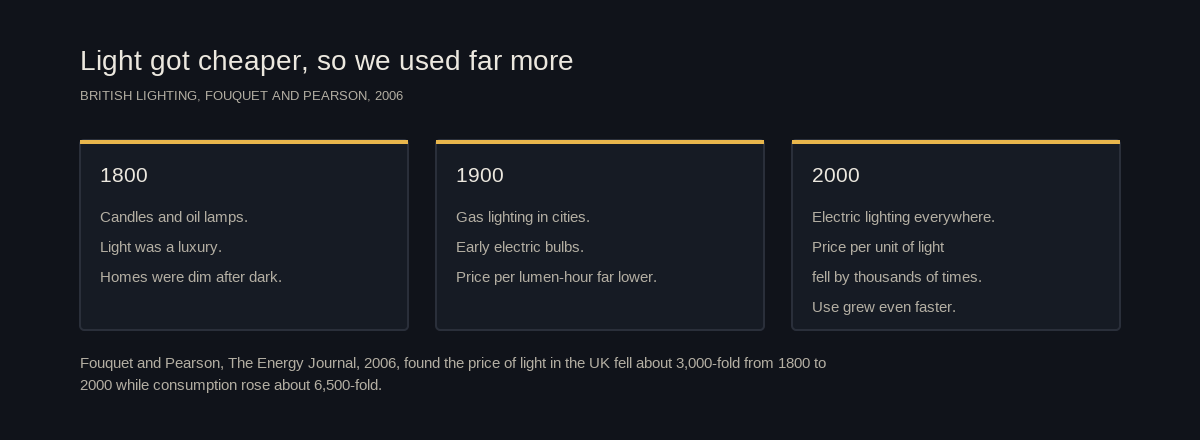
In 2006 Roger Fouquet and Peter Pearson published a study of lighting in the United Kingdom from 1300 to 2000. They found that between 1800 and 2000 the price of lighting services fell about 3,000-fold, while consumption of light per person rose roughly 6,500-fold. Each new technology, gas, kerosene, incandescent electric and fluorescent, made light cheaper, and each time people used far more.
The energy spent on lighting did not fall. Efficiency gains were swallowed and then exceeded by new uses: street lights, shop windows, sports stadiums, illuminated signs.
LEDs and the next round
LEDs are the latest jump. The International Energy Agency reports they now make up most lighting sales worldwide. Some of the savings show up on power bills. Some go into lighting that would never have been worth running before, from decorative facades to all-night building lighting. Researchers are still measuring how the balance comes out.
The pattern is the whole argument of this site in one example. For the bigger picture of energy and civilization, see our flagship Type 2 Civilization.
Common questions
Is all that light wasted?
Not at all. Cheap light made evening reading, safer streets and night work possible. The point is that efficiency raised use rather than cutting it.
Did lighting energy use ever fall?
In some rich countries, lighting electricity has started to fall with LEDs. Whether that lasts as new uses appear is an open question.