The rebound effect
Efficiency always saves something. The question is how much of the saving gets spent on using more.
Three sizes of rebound
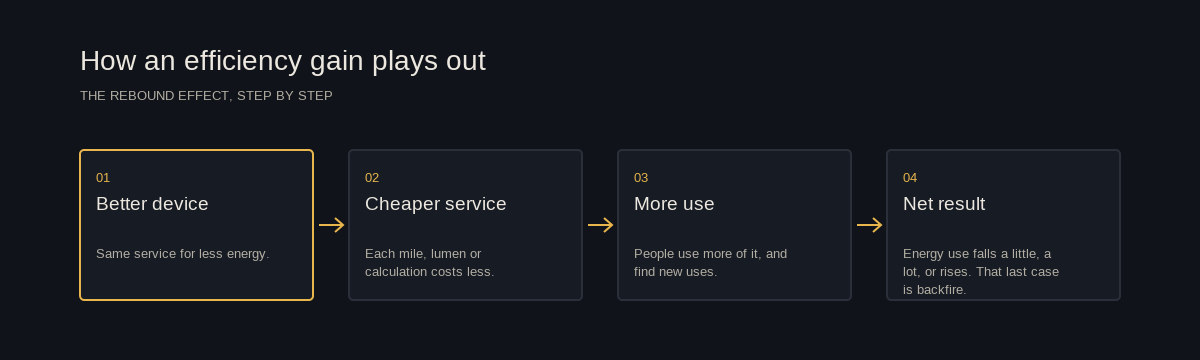
When a device gets more efficient, the energy needed for each unit of service falls. Then behavior responds. If people use a little more, some of the saving is lost. That is direct rebound. If they spend the money they save on other goods, which also take energy, that is indirect rebound. If the two together exceed the saving, total use rises. That is backfire, the Jevons paradox in its strict form.
What the evidence says
Studies of home heating, cars and appliances in rich countries usually find direct rebound between about 10 and 30 percent. Efficient cars still save fuel overall, just less than the engineering estimate. The UK Energy Research Centre reached that kind of range in a large 2007 review.
Backfire is more likely when a technology opens new uses. Steam engines, electric lighting and computing all became so cheap that people found uses nobody had imagined. In those cases the economy-wide effect can exceed 100 percent.
The AI example
In January 2025, a Chinese lab released a model said to match leading systems at a much lower training cost. Some investors feared demand for AI chips would fall. Microsoft chief executive Satya Nadella replied on social media that the Jevons paradox strikes again: as AI gets more efficient and accessible, use will skyrocket.
Whether that holds is an open question. For why AI hardware runs into its own speed limits, see our sister site Amdahl’s Law.
What follows for policy
Rebound does not mean efficiency is pointless. It means efficiency alone may not cut total energy use, especially in fast-growing economies. Many economists pair efficiency standards with energy or carbon prices. The last guide traces the clearest historical case: cheap light.
Common questions
Should I still buy efficient appliances?
Yes. For a household, efficient appliances almost always cut energy use and bills. The paradox is about economy-wide effects over time.
Does rebound apply to renewable energy?
Cheaper clean energy will likely raise total energy use. If that energy is clean, the climate effect differs from cheaper coal.