The Coal Question of 1865
It is wholly a confusion of ideas, Jevons wrote, to suppose that the economical use of fuel is equivalent to a diminished consumption. The very contrary is the truth.
A worried young economist
In 1865 William Stanley Jevons was 29 and lecturing in Manchester. Britain ran on coal, and he asked a blunt question: what happens when it runs low? His book The Coal Question argued that British industrial power depended on cheap coal and that its supply could not grow forever.
The surprising part was his answer to a hopeful reply. Engineers said that better engines would stretch the coal supply. Jevons said the opposite would happen.
The argument
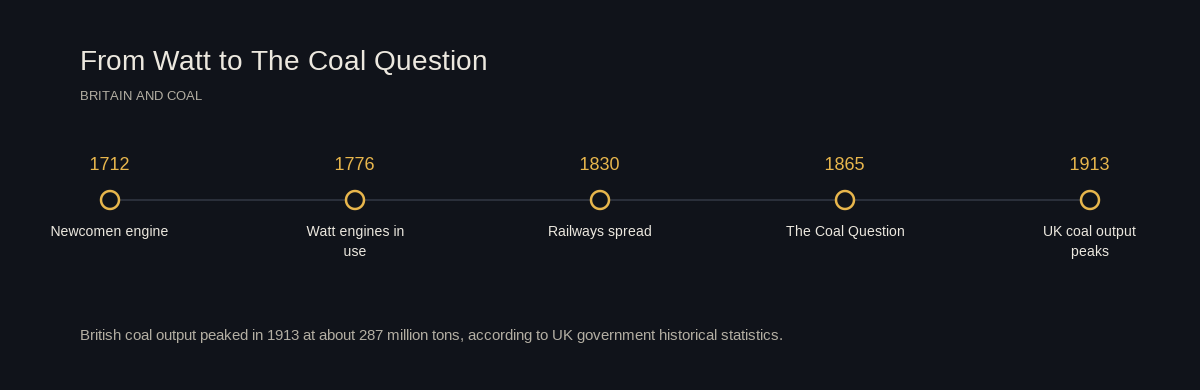
James Watt’s steam engines, which entered use in the 1770s, needed far less coal for the same work than Thomas Newcomen’s earlier design. Jevons pointed out that this did not reduce coal use. It made steam power cheap enough to use in mills, mines, ships and railways that could not afford it before. Total coal burned rose enormously.
His key line is the quote at the top of this page. Making a resource more productive lowers the cost of what it does, and lower cost brings more demand. If demand grows enough, total use goes up.
Was he right?
About coal, mostly yes. British coal output kept rising for almost fifty years after his book, peaking in 1913. He was wrong that Britain would simply run out. Oil and other fuels arrived and changed the picture, as later economists noted.
The paradox itself survived, and it has a name now. Economists call the general effect rebound, and the strong case, where use actually rises, backfire. The next guide explains how rebound works.
Common questions
Is the Jevons paradox a law?
No. It is a pattern that happens under some conditions, mainly when demand for the service is very responsive to price and the resource is a big part of the cost.
Where can I read The Coal Question?
It is in the public domain and free online, including at the Library of Economics and Liberty.